Incremental Shared
Incremental Shared (method=:incremental_shared, the default) reduces repeated encoding cost with two successive approximations: local randomized SVD (rSVD), then incremental sharing of the retained spatial factors. An optional final recompression introduces a third approximation stage. The image and coil maps are not low-rank approximated. The supplied Fourier trajectory is retained, while the numerical NFFT approximation has its own error.
Symbols follow Symbols and notation. For optional global recompression, this page distinguishes the accumulated rank
Readouts use index nSam, nDyn in Julia). The distinct Direct Shared (Global strategy) path constructs a common snapshot space directly and selects its final rank using global residual checks. Both approximate the same pure residual phase matrix; they share the downstream forward, adjoint and weighted normal representation.
Method overview
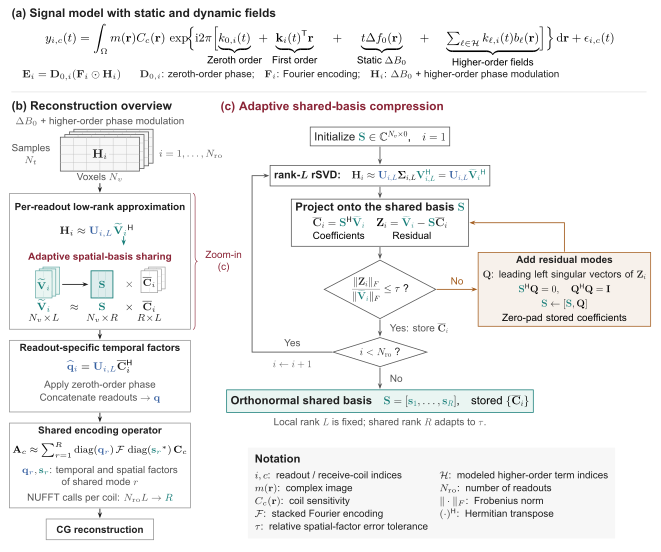
Figure 1. Incremental Shared reconstruction. (a) The signal model separates zeroth-order phase, Fourier encoding, and residual field modulation. (b) Local rSVD factors are combined into a shared spatial basis and readout-specific temporal factors. (c) Readouts
The figure shows the default shared rSVD construction with global_basis_tol=nothing, so
This schematic omits optional final recompression. The stored temporal factors also include normalization and the NFFT centre correction, as detailed in phase folding. The full residual model, including the 2D residual terms and optional concomitant phase, is described below.
The default path is easiest to follow in this order:
- Local rSVD constructs
. - Incremental sharing builds a spatial basis and saved coefficient blocks; earlier blocks are zero-padded when the basis grows.
- Temporal assembly forms
. - Optional recompression rotates and may truncate the completed representation.
- Phase folding and NFFT implement the final forward, adjoint, and weighted normal operators.
The local and incremental stages introduce separate approximation errors. Temporal assembly and phase folding add no intended truncation. Optional final recompression adds error relative to the already shared representation. It cannot recover components discarded earlier.
Relation to previous methods
Separable temporal-spatial representations of higher-order MRI encoding have previously been obtained using singular-vector separation, and related decompositions are used in expanded-model reconstruction such as MaxGIRF. [2] [3] The randomized range-finding step used here follows standard rSVD methods. [4]
HighOrderMRI combines matrix-free per-dynamic factorization with an incrementally constructed shared spatial basis and a global-trajectory NFFT representation. The resulting shared basis is not an exact post-hoc global SVD of all dynamic-specific matrices. Consequently, the Eckart-Young optimality result for a truncated SVD of a fixed matrix does not apply directly to the completed incremental representation. [5]
Related inverse problems include hybrid regularization with static off-resonance correction [18] and Cartesian MaxGIRF for EPI with gradient nonlinearity and concomitant fields. [19] Their field models and reconstruction objectives should be specified separately from the choice of low-rank factorization.
The implementation's contribution is the combination of singular-value-weighted online sharing, matrix-free phase products and reuse of the completed common basis over the full Fourier trajectory. SVD, randomized range finding and subspace projection are established tools. Related group-patch joint compression also exploits MRI encoding redundancy, including B0 and RF modulations, with a different construction and grouping objective. [20] Claims about reduced memory, construction cost or reconstruction time require measurements at matched accuracy; these properties do not follow from an optimal-rank theorem for the incremental algorithm.
A direct global SVD/rSVD remains a useful approximation-quality reference when memory permits because all dynamics can be considered jointly. The incremental method instead targets memory-bounded construction and scalable execution. These alternatives are distinguished explicitly in Scientific validation strategy.
Shared subspace and hierarchical POD constructions also have established mathematical foundations, including HAPOD. [23] HAPOD's tree construction and tolerance allocation differ from this streaming merge; its error theorem is not a certificate for the present implementation.
For local fixed-precision approximation, Yu et al. give QB energy identities with orthogonality and finite-precision requirements. [21] Demmel et al. describe TSQR, a stable alternative to forming a tall matrix's Gram before SVD. [22] These are numerical references, not additional constructor backends.
Residual encoding matrix
For dynamic
All phase features are real. Time is in seconds, the off-resonance map is in Hz, and each integrated coefficient/basis product is in cycles; the forward phase sign is positive. Stacking every actual readout gives
This pure phase matrix excludes coil sensitivities, data weights, NFFT centre correction and normalization. Its relative Frobenius error is the common phase-approximation target for both shared constructions.
The zeroth-order temporal phase and the first-order Fourier terms are excluded from
Concomitant phase in the residual model
The optional term in the residual exponent is zero when concomitant=nothing. For supplied coefficients,
The four basis columns and corresponding coefficient rows are appended before residual basis construction. This applies to the selected shared or per-readout representation; the nominal first-order NFFT trajectory is unchanged. recon_terms selects only the original spherical-harmonic rows, and kspha still has 9 or 16 rows at the public interface.
op = HighOrderLowRankOp(grid, kspha_dynamic, times_dynamic;
    fieldmap, csm, mask,
    concomitant=concomitant_coefficients,  # (4,nSam,nDyn), cycles/m²
)
A single-dynamic call also accepts (4,nSam). With concomitant=nothing, no extra phase buffers are appended. Match the coefficient coordinate frame and physical origin to the grid, and convert rad/m² to cycles/m² by dividing by times again. See the encoding model for the common convention.
Per-dynamic randomized SVD
Let L_rank, rsvd_oversample, and
is generated, and the randomized range sketch is computed as
The projected adjoint matrix is then
Products with times, fieldmap, the residual rows of kspha, and the corresponding spatial basis functions. For a fixed configuration, dynamic
The current implementation uses one Gaussian sketch and QR range finding, without power iteration. The retained rank
With voxel-distributed setup, worker
Direct SVD finalization
For rsvd_finalize=:svd, let
Retaining the first
and therefore
Because
The singular values of the projected matrix
Small-Gram finalization
For rsvd_finalize=:gram, the implementation forms
and diagonalizes
The retained factors are recovered as
If
Local projection error and sketch conditioning
In exact arithmetic, either supported finalization gives
Within the sampled range
This separates missed range information from truncation within that range. For a full SVD partition
To see this, the rank-
The local identity
Independent per-readout representation
Set method=:per_readout to retain each local pair
op = HighOrderLowRankOp(grid, kspha, times;
    fieldmap, csm, mask,
    method=:per_readout,
    L_rank=6,
    rsvd_oversample=5,
)
For each readout and coil, let
The same zeroth-order phase, centre correction, and normalization are folded into the temporal factors. With resident factors, one NFFT plan is cached per readout, giving
CPU storage and GPU lookahead
To bound GPU memory for a large independent factor bank, keep the factors in host RAM and use a readout queue:
op = HighOrderLowRankOp(grid, kspha, times;
    fieldmap, csm, mask,
    arrayType=CuArray,
    method=:per_readout,
    per_readout_storage=:cpu,
    per_readout_cache_size=5,
    L_rank=6,
    rsvd_oversample=5,
)
Each normal-operator worker caches at most five readouts in this example. A separate CUDA stream copies future factors through one pinned host staging buffer. A single NFFT plan per worker updates its trajectory on the compute stream. Ready/consumed events prevent a slot from being used before its transfer completes or overwritten before its transforms finish. Completed slots are replenished while another slot computes. The same queue is used by the forward, adjoint, and multi-GPU normal operator. The source operator owns a separate queue for forward and standalone adjoint evaluations on the primary GPU.
Once the multi-GPU normal backend has been initialized, adjoints reuse its workers and queues, distributing readouts and evaluating all coils for each readout together. Each spatial factor block is then transferred once across the worker group. This also parallelizes the solver's initial adjoint without changing its weights or independent spatial factors.
For CG itself, select normal_distribution=:readout to assign disjoint readout ranges to workers, evaluating all coils for each assigned readout. Each factor block is then streamed once across the worker group per normal application, while all coil sensitivity maps are kept on each active GPU. normal_distribution=:channel retains the existing coil partition, with each worker traversing every readout. These compute the same weighted normal operator up to floating-point summation order.
Only storage and scheduling change: the full independent spatial bank still occupies per_readout_storage=:gpu materializes independent factors and plans on the selected array backend: GPU for CuArray, CPU for Array. The :cpu and :regenerate modes require CUDA and bound cache slots rather than the complete host/device memory footprint.
Pipelined setup aggregation
Voxel-distributed per-readout setup uses per_readout_gather=:pipeline by default. Each GPU has two pinned host buffers and a separate collector worker. Downloads and host writes can overlap later rSVD phases. A CUDA event delays the next overwrite of the spatial factor until its download finishes; a host buffer is reused only after its final write completes. The queue is bounded to two outstanding readouts. per_readout_gather=:synchronous retains the blocking gather for comparisons. The independent factors and their precision are unchanged, and the full host factor bank is still required.
Provide threads for compute workers, factor collectors, and a coordinator when using the pipeline. A smaller thread count can reduce overlap while the queue remains bounded. See runtime requirements.
On-demand regeneration
When the independent spatial bank exceeds host RAM, use per_readout_storage=:regenerate with rsvd_distribution=:voxel, rsvd_backend=:kernel and rsvd_finalize=:gram. This retains each readout's original unmodulated
with the existing matrix-free adjoint kernel. Uncached spatial blocks are generated as needed, rather than materializing the complete spatial bank. No additional singular-value truncation is introduced; GPU partition/GEMM geometry may change rounding, so validate the factor and operator errors for the workload. The temporal normalization and zeroth-order/centre phases remain in the operator's q, separately from Q/Z.
per_readout_cache_size=1 generates and consumes factors serially. Values of 2 or more enable an independent producer task/stream to prepare future readouts while the consumer evaluates all coils of the current readout. Each slot has ready/consumed events and is never overwritten while in use. Generation and NUFFT share GPU compute resources; lookahead is an opportunity to overlap work, not a guarantee that generation cost disappears.
per_readout_host_cache_bytes sets an optional host factor budget (default zero). Whole factor blocks from a fixed, evenly spaced subset are materialized during setup; all GPU workers reuse the same bank. Fixed residency avoids evicting every cached readout during repeated sequential CG sweeps. The budget excludes Q/Z, field maps, workspaces and pinned staging. The budget applies only to resident spatial factor blocks, not to Q/Z, the phase model, generator workspaces, or GPU slots. The source operator and each normal worker own bounded GPU slots and a generator workspace; close(op) releases these workers/caches, which are recreated lazily if the operator is subsequently reused.
Comparison scope
Both representations use the same local rSVD model. Changing method selects independent or shared factors. shared_rank_max and shared_basis_tol are unused for independent factors; global_basis_tol must be nothing for method=:per_readout. A zero shared tolerance still constructs a shared basis and does not select the independent representation. See the storage reference.
The independent factorization and per-readout NUFFT sums follow the MAXGIRF author's encoding implementation. This switch retains HighOrderMRI's local rSVD implementation. Supply concomitant separately to include its phase; the layout does not estimate physical coefficients or promise bitwise reproduction of the MATLAB reconstruction.
Incremental shared spatial basis
Independent local factorizations would retain up to
Before processing dynamic
The current spatial factor is first projected onto the existing basis,
and the residual is
A second projection/subtraction is performed in the implementation and the corresponding correction is accumulated in
The residual Gram matrix is decomposed with eigenvalues in descending order as
The residual Gram is accumulated in ComplexF64 on both local and voxel-distributed paths, including for Float32 input factors. Its small eigendecomposition and spectral rank selection use Float64; stored basis vectors, coefficients, and NFFT products retain the requested precision. This behavior is automatic. It applies to the incremental shared residual Gram, separately from local rSVD finalization.
The minimum number
where shared_basis_tol. The denominator
For the selected positive residual eigenvalues, the appended basis vectors are
Write the appended residual modes as
and the coefficient block for the current dynamic is completed as
At the time dynamic
If the required accumulated rank would exceed shared_rank_max, setup terminates with an error rather than relaxing the requested rank bound.
Streaming coefficient representation
The implementation is memory bounded: after dynamic
Let
be the completed shared basis, and let
For an earlier dynamic, however, the stored coefficient block is generally not the orthogonal projection onto the completed basis:
Appending basis columns and padding earlier coefficient blocks with zeros leaves the previously stored approximation unchanged. The final coefficients should therefore be interpreted as streaming coefficients associated with the incremental construction, rather than as coefficients from a post-hoc global projection.
Optional no-add check
shared_noadd_check=false is the default. With voxel-distributed shared rSVD, the opt-in check can avoid the residual-Gram eigendecomposition when the existing basis is already sufficient. It keeps the original two-pass projection, coefficient correction, and full residual computation.
For a nonempty shared basis, workers sum the residual energy in FP64:
A conservative guard compares this energy with
This is a setup optimization for the default rSVD method. It neither prunes ranks during CG nor selects the reconstruction distribution. Conditions and defaults are listed in the LowRank reference.
Optional final global recompression
The completed incremental representation is global_basis_tol=nothing, retain it unchanged:
If
For a nonempty input representation, the implementation keeps at least one direction. The displayed rotation is used when the rank is reduced; when all columns are retained, the input factors are returned unchanged without rotation. Numerically negligible total energy also leaves the factors unchanged. The reported relative error is additional to local rSVD and incremental sharing error. It does not recover earlier discarded components or certify image error. Gram and basis-orthogonality roundoff remain separate numerical limitations. Recompression occurs before the temporal phase and normalization folding. For global_basis_tol >= 1, the current reported discarded-energy diagnostic can be inconsistent with the forced minimum rank of one. Do not treat that diagnostic as a checked error bound in this range; no numerical implementation change is included here.
Sampled construction and coefficient refitting
shared_fit_samples replaces the saved local temporal coefficients with an all-time gappy fit to the completed spatial basis. If fitting voxels J are selected by
The code forms the sampled pseudoinverse in ComplexF64 and evaluates all original time rows in chunks. Without shared_readout_count, every readout still contributes local factors to the basis. With that option, readouts are selected by farthest-point traversal of a sampled phase-geometry proxy: 1024 spatial draws estimate feature covariance, and up to seven evenly spaced time samples represent each readout. The original readout indices determine their local rSVD seeds. Fitting voxels are a uniform subset without replacement, distinct from Direct Shared's pivoted-QR selection.
Refitting changes the approximation:
Fixed-rank and weighted recompression
global_basis_rank, global_basis_weights, or global_basis_coil_weighting=true select a separate compression path that accounts for the actual spatial Gram. For input factors
When
In exact arithmetic, this gives the best rank-R approximation of the input representation in
global_basis_weights supplies
Construction scope
This page derives Incremental Shared, the local-rSVD plus incremental-sharing path. Direct Shared (Global strategy) instead constructs one common snapshot parent, fits all actual time rows and recompresses the completed coefficient matrix. Its global H target, conditional error bounds and empirical rank-selection policy are described separately. Direct Shared's Per-readout strategy uses sampled per-readout checks. Its construction and acceptance differ from Global. The retained anchors above preserve existing links; the corresponding derivations are now on the joint theory page.
Final residual representation
For rSVD, first assemble the unscaled incremental sample-domain factor
Stack all dynamic blocks with samples varying fastest. Optional global recompression produces
The stored temporal matrix additionally folds in:
- the zeroth-order phase
; - the parity-dependent NFFT centre correction
; - the symmetric normalization
.
Thus the actual stored rows are
The first-order Fourier phase stays in the NFFT. Here
Forward and adjoint operators
Let
The complex conjugation of
The corresponding multi-coil adjoint is
These expressions agree with the implemented conjugation pattern: the forward operator multiplies the image by the coil sensitivity and the conjugated shared-basis vector before the NFFT, whereas the adjoint applies the conjugated temporal coefficient, the NFFT adjoint, the conjugated coil sensitivity, and the non-conjugated shared-basis vector.
Without sample batching, each shared transform evaluates the concatenated trajectory. The number of NFFT evaluations per forward or adjoint application is
For independent per-dynamic spatial factorizations, the corresponding transform count would scale approximately as
Weighted normal and rank execution
Let recon_HOOp repeats the same block for every coil. The data normal is
Summing only per-rank normals omits the
For rank batch size
Two-stage approximation error
For the rSVD path, before optional global recompression and before temporal phase/normalization folding, the approximation is
The triangle inequality gives
Since
and therefore
The first term is the local rSVD approximation error and the second term is the incremental shared-basis approximation error. shared_basis_tol controls only the second stage relative to the retained local energy
Orthogonal decomposition and a stacked bound
The orthogonal local projection permits a stronger identity than the triangle inequality. The local residual is orthogonal to
Let
Zero-padding old coefficient blocks preserves each old approximation, so this inequality does not require a post-hoc refit to the final basis. With
This is a conditional exact-arithmetic result: the stacked bound needs the true local projection and the stated actual residual inequalities. Orthonormal spatial updates are additionally used to infer those residual inequalities from the residual spectrum. For numerical factors, orthogonality defects, phase-product roundoff and weak-spectrum decisions add errors. The reported Gram-tail estimates are not rigorous Float32 certificates. In particular
Additional final compression
For the stacked original phase matrix
The second term is controlled relative to the already shared representation, not relative to
The local residual remains orthogonal to the final representation: each recompressed readout still has sample-domain columns in the range of
If the final stage actually satisfies
The sharing error is orthogonal to the basis available at its insertion time, but can have components along columns added later. A global rotation and truncation can mix these columns, so
Guarantees, empirical choices and contribution
| Statement | Scope |
|---|---|
| Local projection identity and spatial-factor error transfer | Exact-arithmetic identities under the displayed orthogonality conditions. |
| Stacked local-plus-shared bound | Conditional on each actual shared residual satisfying its threshold. |
| Small-SVD optimality | For the projected matrix or residual being decomposed, not the entire completed streaming construction. |
| Final shared rank is globally minimal | Not established; saved old coefficients are not refitted, and profile order can matter. |
| A configured local rank or shared tolerance certifies total H error | Not established; evaluate the original H residual of the final factors. |
| Lower memory or faster reconstruction | Implementation/workload properties requiring matched-accuracy measurements. |
The method-specific design is weighted online spatial sharing without retaining all local spatial matrices, followed by a reusable common-trajectory execution. Its joint alternative uses a different construction objective and error-selection policy. Neither path treats SVD, POD or randomized range finding as a new mathematical invention.
From H error to encoding and reconstruction error
For the point-voxel model, stack actual time rows as
Thus a global H tolerance is an unweighted average, whereas encoding error depends on coil and data weights. With unit weights and
An illustrative inverse-problem bound makes the remaining dependence explicit. Consider converged linear Tikhonov solutions minimizing
Consequently
Here
Thus the denominator is always at least
This identity follows by subtracting the two normal systems. It illustrates dependence on conditioning, regularization, the data residual and weighted operator error. It is not a guarantee for arbitrary regularizers or singular unregularized systems. A finite CG output has the additional error to its own converged solution. NFFT, low-rank and iterative errors must therefore be validated separately;
Parameter interpretation
For the default rSVD construction:
| Parameter | Stage | Meaning |
|---|---|---|
method | Construction | Per-readout, Incremental Shared, or Direct Shared factors. |
L_rank | Local rSVD | Fixed retained rank |
rsvd_oversample | Local rSVD | Additional sketch columns; |
rsvd_seed | Local rSVD | Base seed; backend and partition also determine the actual sketch. |
rsvd_finalize | Local rSVD | Direct SVD or projected Gram finalization. |
rsvd_backend | Local products | Chunked products or fused kernels; internal 16-column batches do not cap total rank. |
shared_basis_tol | Incremental merge | Residual tolerance relative to retained local energy |
shared_rank_max | Incremental merge | Cap on accumulated rank |
shared_noadd_check | Incremental merge | Optional guarded residual-energy check; default false. |
global_basis_tol | Final recompression | Additional error relative to the completed representation; default nothing. |
normal_distribution | Execution | Select single, channel, rank, or independent-readout execution. |
normal_sample_batch_size | Rank execution | Bound sample batches, not total memory; default 12_000_000. |
The local rank
Use the API reference for exact defaults and supported combinations, and the multi-GPU guide for runnable configuration. Approximation and adjoint checks should use a tractable explicit or directly constructed reference with the same mask and phase conventions. Validation methodology is described separately in Scientific validation strategy.
Validation scope
Regression tests assess consistency of phase sign, coordinate convention, NFFT node mapping, centring, normalization, masking, data layout, and adjointness on tractable problems. These tests establish implementation consistency but do not constitute an independent physical reference. Validation of absolute physical accuracy requires independent simulation or measured reference data.